In civil engineering, oil and gas, water transmission, wastewater systems, and industrial infrastructure projects, selecting the right type of pipe plays a decisive role in the success or failure of a project. Among the various options available, spiral welded pipes have gained a prominent position as one of the most widely used and highly engineered types of steel pipes in large-scale projects.
By focusing on production quality, process control, and compliance with international standards, Mahyar Sepahan Company has been able to deliver spiral pipes that are fully optimized from the design stage through final installation. In this article, we examine the real-life journey of spiral pipes from the production line to the installation site and analyze their actual performance in projects.
What Is a Spiral Pipe and Why Is It Chosen for Projects?
Content list
A spiral pipe (Spiral Welded Pipe) is a type of steel pipe manufactured from steel strips or plates formed into a helical shape, with a continuous welded seam. This spiral structure allows stresses to be distributed more evenly along the pipe body, significantly improving its mechanical strength.
Key Advantages of Spiral Pipes
Higher pressure resistance compared to many longitudinally welded pipes
Ability to produce large diameters at lower cost
Reduced stress concentration at the weld seam due to the spiral structure
High flexibility in design and execution for complex projects
For these reasons, spiral pipes are the preferred choice for many large-scale fluid transmission projects.
Stage One: Raw Material Selection and Quality Control
The real performance of spiral pipes begins at the very first stage: steel plate selection. According to international standards, the quality of raw materials has a direct impact on the service life of the pipe.
At Mahyar Sepahan, steel plates are selected in compliance with recognized global standards such as:
API 5L
ASTM A252
EN 10219
Strict control of chemical composition, mechanical properties, and thickness uniformity ensures that the final pipe maintains reliable performance under real operating conditions.
Stage Two: Spiral Pipe Manufacturing Process
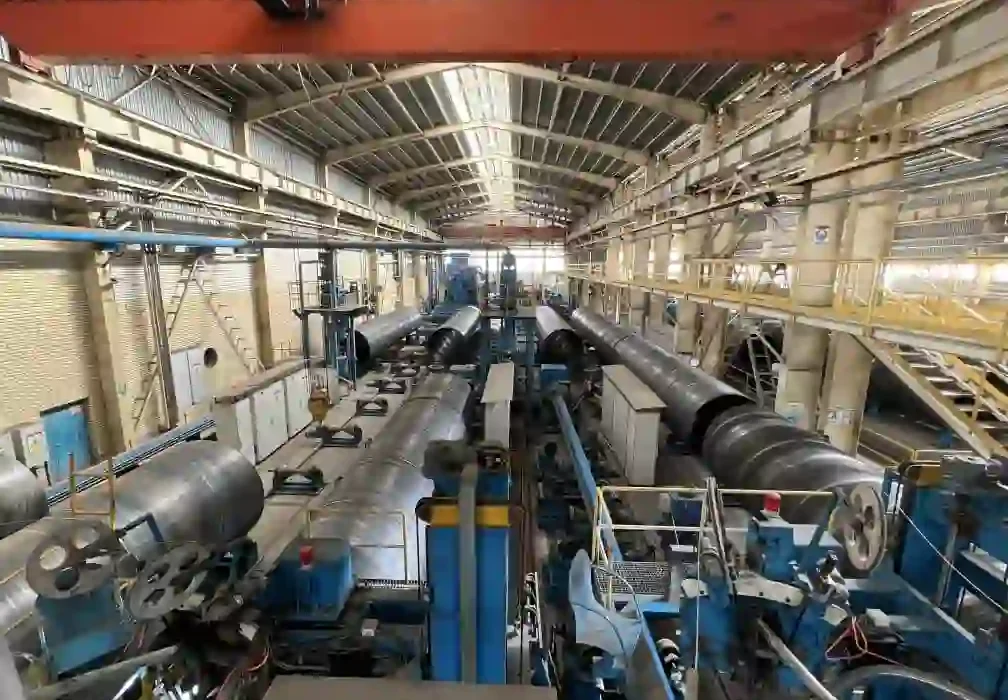
The manufacturing process of spiral pipes is a fully engineered operation in which each step directly affects the final product quality.
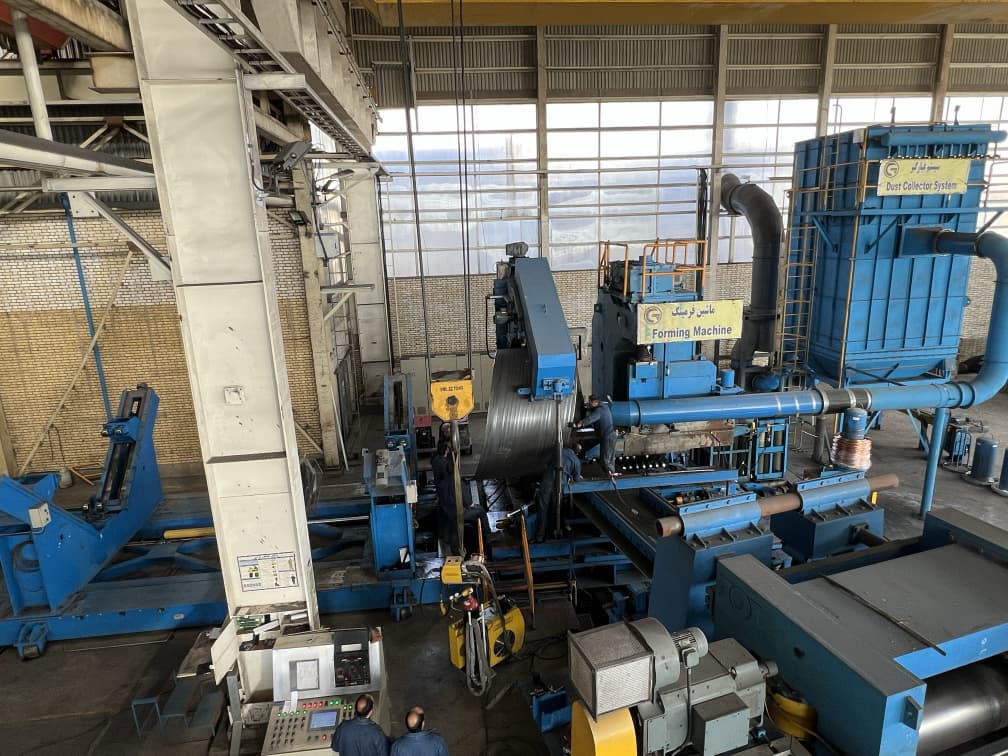
Spiral Forming
Steel plates are continuously fed into the forming line and shaped into a spiral at a specific angle. This angle is calculated based on the final pipe diameter and the required operating pressure.
Precision Multi-Layer Welding
The spiral seam is welded using advanced Submerged Arc Welding (SAW) technology, which offers:
Deep weld penetration
Uniform weld strength
Minimal risk of welding defects
Non-Destructive Testing
After welding, the pipes undergo non-destructive testing methods such as:
Ultrasonic Testing (UT)
Radiographic Testing (RT)
These tests ensure that even the smallest potential defects are detected.
Stage Three: Coating and Corrosion Protection
One of the most critical factors in the real performance of spiral pipes is corrosion resistance. Many projects are executed in humid environments, aggressive soils, or industrial areas.
Common Coating Systems
Internal epoxy coating to reduce fluid friction
External polyethylene or polypropylene coating
Bitumen or FBE coating for special applications
At Mahyar Sepahan, coating systems are selected based on project conditions, fluid type, and required service life, not as a one-size-fits-all solution.
Stage Four: Transportation and Storage
Even the highest-quality spiral pipe can be damaged if transportation and storage are not handled properly.
In professional projects, the following principles are observed:
Use of standard lifting equipment
Prevention of direct contact between pipes and the ground
Control of impacts and bending during loading and unloading
These seemingly simple details have a significant effect on the pipe’s final performance at the installation site.
Stage Five: Spiral Pipe Installation in Projects
The real performance of spiral pipes becomes evident during installation and commissioning.
Alignment Accuracy and Field Welding
Precise alignment and high-quality field welding are critical. The spiral structure helps distribute stresses more evenly, reducing the risk of cracking at welded joints.
Pressure Testing and Commissioning
After installation, pipes undergo hydrostatic pressure testing. In projects using high-quality spiral pipes, test results typically demonstrate:
Minimal leakage
High stability under operating pressures
Reliable long-term performance
Real Performance of Spiral Pipes in Different Types of Projects
Water Transmission Projects
In urban and intercity water transmission lines, spiral pipes are an ideal solution due to their large diameters and cost efficiency.
Oil and Gas Projects
In low- and medium-pressure pipelines, spiral pipes manufactured in accordance with API standards provide reliable performance under harsh environmental conditions.
Industrial and Structural Projects
In piling applications, marine structures, and special industrial uses, the mechanical strength and design flexibility of spiral pipes are major advantages.
Why Is Mahyar Sepahan the Right Choice for Spiral Pipes?
Mahyar Sepahan is not merely a pipe manufacturer, it is a provider of integrated engineering solutions.
Key differentiators include:
Strict adherence to international standards
Multi-stage quality control systems
Capability to produce customized sizes and specifications
Proven experience in real-world projects
These strengths enable the company’s products to deliver performance that exceeds expectations under actual operating conditions.
The Role of Engineering Design in Real Spiral Pipe Performance
The importance of engineering design prior to production is often underestimated. In real projects, pipe selection should not be based solely on diameter and thickness; multiple parameters must be considered, including:
Operating and maximum pressure
Type of conveyed fluid (water, wastewater, chemicals, gas)
Operating temperature
Environmental conditions and soil type
Pipeline length and number of joints
At Mahyar Sepahan, these parameters are carefully analyzed before production to ensure the spiral pipe is fully aligned with project requirements, reducing future maintenance costs.
Mechanical Behavior of Spiral Pipes Under Real Conditions
In operating environments, pipes are exposed not only to internal pressure but also to lateral forces, soil settlement, temperature variations, and vibrations from industrial equipment.
Stress Distribution in Spiral Structures
Unlike longitudinally welded pipes, the spiral structure distributes stresses along the pipe length, which:
Reduces the risk of sudden failure
Increases resistance to combined loads
Extends the service life of the system
This advantage is especially critical in uneven terrain or seismic regions.
Performance Comparison with Other Steel Pipe Types
Spiral Pipe vs. Longitudinal Welded Pipe
Lower production cost
Capability for larger diameters
Greater design flexibility
Spiral Pipe vs. Seamless Pipe
Seamless pipes offer high strength but at significantly higher cost
For large diameters, spiral pipes are a more economical and practical solution
Spiral pipes provide reliable performance for many industrial applications
For these reasons, spiral pipes are often selected as the optimal balance between cost and performance in large-scale projects.
Impact of Installation Quality on Final Performance
Even the best spiral pipe can underperform if installation quality is poor. Therefore, coordination between the manufacturer and installation teams is essential.
Key Installation Considerations
Proper preparation of the installation bed
Compliance with field welding standards
Use of skilled and qualified personnel
Post-installation inspection and testing
Mahyar Sepahan provides technical consultation and engineering support to ensure maximum real-world performance at the project site.
Durability and Long-Term Service Life
Long-term stability is one of the main indicators of real spiral pipe performance. International project evaluations show that high-quality spiral pipes can operate for decades without performance degradation when proper coating and installation practices are followed.
Factors Affecting Service Life
Weld quality
Type of corrosion-resistant coating
Environmental conditions
Periodic maintenance programs
Adhering to these factors significantly reduces the project’s Life Cycle Cost (LCC).
Spiral Pipes from an Economic Perspective
Real performance is not limited to mechanical strength—it also includes economic efficiency.
Due to:
High production speed
Reduced material waste
Ease of transportation and installation
Spiral pipes help shorten project timelines and lower overall costs, making them a preferred option for large infrastructure projects.
The Future of Spiral Pipes in Infrastructure Projects
With urban expansion and increasing demand for water and energy transmission, the need for large-diameter, high-performance pipelines will continue to grow. Spiral pipes, with their adaptability to advanced welding and coating technologies, will remain a key solution in the industry.
Mahyar Sepahan continues to upgrade its production processes to meet the evolving demands of future projects.
Conclusion
From the production line to the installation site, the real performance of spiral pipes is the result of a fully integrated chain of engineering, manufacturing, and execution factors. Proper material selection, compliance with international standards, effective coating systems, safe transportation, and professional installation all contribute to long-term success.
With a comprehensive understanding of this value chain, Mahyar Sepahan delivers spiral pipes that offer reliability, durability, and economic efficiency under real operating conditions.